
Course description
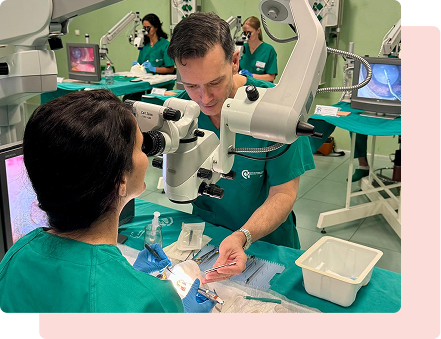
The course is divided into three consecutive days that are designed to explore the most important aspects of surgical technique for ophthalmic cases. Each day is dedicated to a selection of topics including eyelid, cornea, and lens as well as glaucoma surgeries. There are a series of short lectures in the mornings followed by surgical technique laboratories that fill the afternoons.
Please refer to the course outline and course schedule below.
Course outline
Eyelid surgery principles and techniques. Wet lab – often overlooked knot tying skills and a variety of reconstructive eyelid surgery techniques (1h 45 min of lectures and 4h of lab time).
Corneal surgery principles, corneal tying techniques and reconstructive techniques. Wet lab – a variety of corneal surgeries and knot tying techniques are discussed, including techniques to bury corneal knots or to turn them into the suture track, techniques for long corneal incisions (i.e., for ICLE), oblique laceration repair, and corneal reconstructive techniques including use of biomaterials, all under the practical guidance of experienced surgeons in the fields of human and veterinary medicine (2 1/2 h of lectures and 4h of lab time).
Lens and glaucoma. This day is aimed at veterinary surgeons undertaking ophthalmology residency training programs or who are already offering lens surgery at their practice and would like a day of expert guidance and review of their approach and technique.The day ends with a hands-on, guided practical on the placement of gonioimplants (3h of lectures and 3 1/2h of lab time)
Pre-recorded lectures (online, available after successful application)
- Eyelid instrument selection and magnification (RS) (39 min)
- Microsurgical instrument selection and magnification (RS) (47 min)
- Viscoelastic devices and implants in veterinary ophthalmology (DG) (30 min)
- POV, Master topic: The human perspective – Corneal transplantation (LB) (20 min)
- POV what differences do you see between VO and HO? Are we doing a good job? (30 min)
Course schedule (onsite)
08.45 – 09.00 : Introduction (DG)
09.00 – 09.30: Principles of eyelid suturing and knot tying (LB)
09.30 – 10.30: PRACTICAL: Skills – principles of knot tying on skills board (LB, DG, RS, JW)
10.30 – 11.00: Tea/ coffee
11.00 – 11.30: Primary eyelid closure: Tarsal plate suture and figure of 8 (RS)
11.30 – 12.15: Overview of other eyelid techniques (DG)
12.15 – 13.30: PRACTICAL: Primary eyelid closure on cadaver tissue (LB, DG, RS, JW)
13.30 – 14.30: Lunch
14.30 – 15:30: PRACTICAL : reconstructive eyelid surgery on cadaver tissue (LB, DG, RS, JW)
15.30 – 15.45: Tea/ coffee and Residents Meeting I – (DG / RS))
15.45 – 17.15: PRACTICAL: Reconstructive eyelid surgery on cadaver tissue (LB, DG, RS, JW)
17.15 – 17.30: Debrief and Learning Points
Day 2 (May 8, Thursday) – Corneal Surgery
09.00 – 09.30: Corneal surgery I – Needle handling, tying a knot and compression zones (RS)
09.30 – 10.15: Corneal surgery II – Oblique wounds, buried knots and the locking bite (RS)
10.15 – 11.15: Corneal surgery III – Conjunctival pedicles, CLCTs and biomaterials (RS)
11.15 – 11.45: Tea/ coffee
11:45 – 13:30: PRACTICAL: Corneal surgery (LB, DG, RS, JW)
13.30 – 14:30: Lunch
14.30 – 16.00: PRACTICAL: Corneal surgery (LB, DG, RS, JW)
16.00 – 16.30: Tea/ coffee an Residents Meeting II (DG / RS)
16:30 – 17.30: PRACTICAL: Corneal surgery (LB, DG, RS, JW)
17.30 – 17.45: Debrief and Learning Points
Day 3 (May 9, Friday) – Lens and glaucoma Surgery
09.00 – 10.00: Technical aspects of phacoemulsification machines (LB)
10.00 – 10.50: Phacoemulsification surgical technique (DG)
10.50 – 11.20: Tea/ coffee
11.20 – 12:10: Problem solving in cataract surgery for residents I (RS)
12:10 – 13:00: Problem solving in cataract surgery for residents II (RS)
13.00 – 14.00: Lunch
14.00 – 16.00: PRACTICAL: small incisions for lens surgery, capsulorrhexis techniques (LB, JW, DG, RS)
16.00 – 16.30: Tea/ coffee and Residents Meeting III (DG / RS)
16.30 – 17.30 PRACTICAL: gonionimplantation and continuation of other skills (LB, DG, RS, JW)
17.30 – 17.45 Debrief and Learning Points